
Theatre Of
The Oppressed
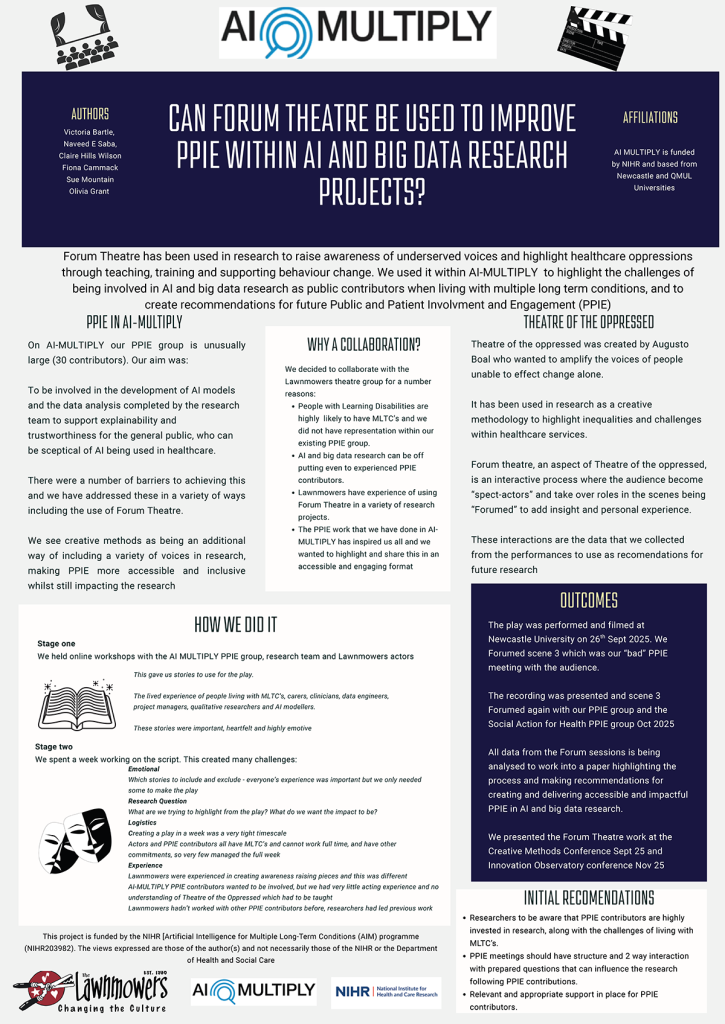
Theatre of the oppressed was created by Augusto Boal who wanted to amplify the voices of people unable to effect change alone.
It has been used in research as a creative methodology to highlight inequalities and challenges within healthcare services.
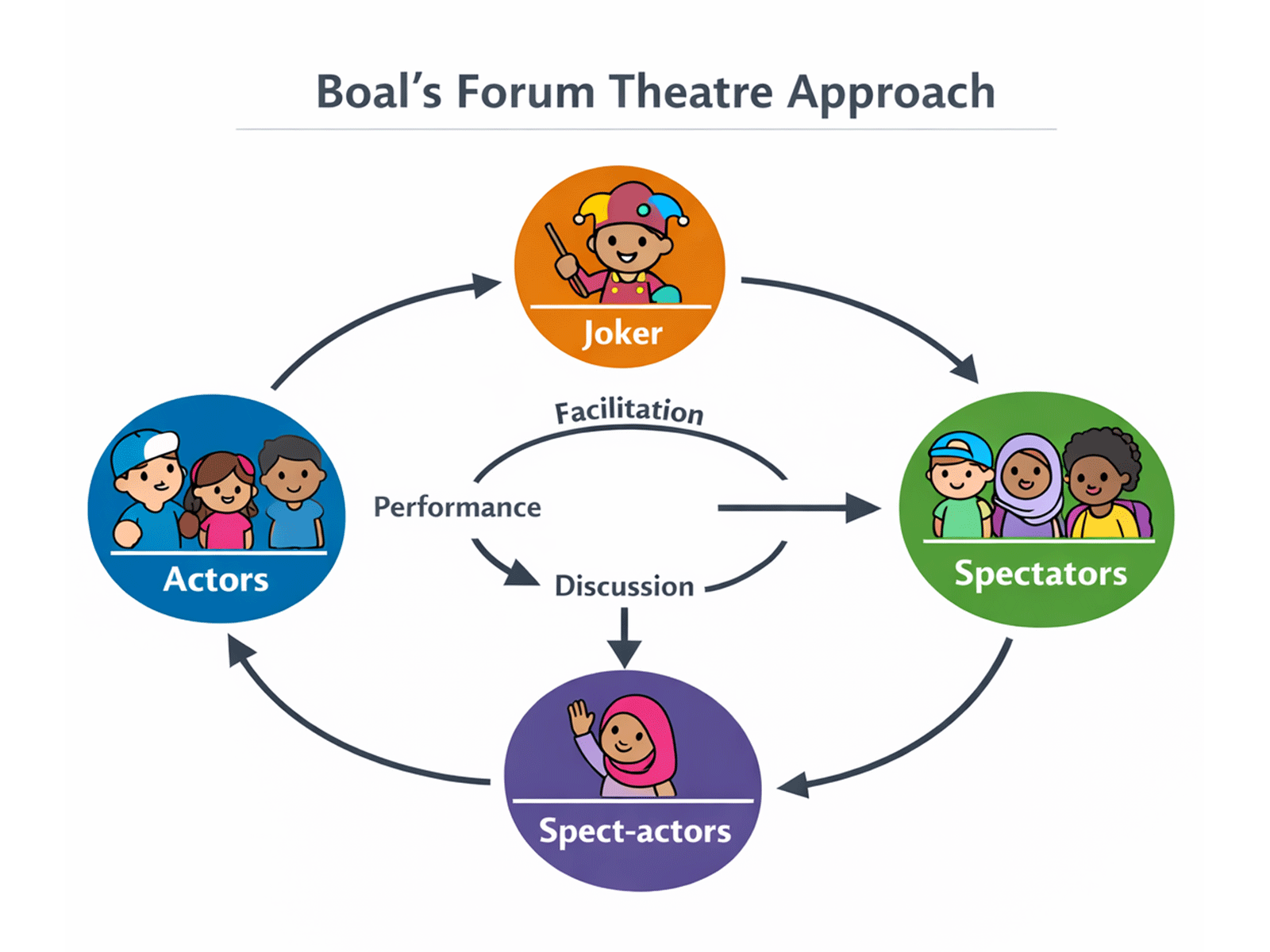
Forum theatre, an aspect of Theatre of the oppressed, is an interactive process where the audience become “spect-actors” and take over roles in the scenes being “Forumed” to add insight and personal experience.
These interactions are the data that we collected from the performances to use as recommendations for future research.
Why use Forum Theatre?
A key benefit of Forum Theatre was the ability to involve both the research team and PPIE contributors. This helped ensure the resulting piece was representative of the whole study community, rather than focused solely on PPIE contributors. It included clinicians, data scientists, project managers, and other research disciplines involved in the project.
Forum Theatre creates a safe, participatory space in which people with MLTCs can share lived experiences, challenge power imbalances, and collectively explore alternative ways of engaging with AI research, a field that is often abstract and expert-driven. By making complex issues tangible, it opens up meaningful dialogue between contributors and researchers.
Importantly, Forum Theatre places all participants on an equal footing and supports the identification of issues, discussion of challenges, and co-creation of solutions in a safe and creative environment.

Why a collaboration?

We decided to collaborate with the Lawnmowers theatre group for a number reasons:
- People with Learning Disabilities are highly likely to have MLTC’s and we did not have representation within our existing PPIE group.
- AI and big data research can be off putting even to experienced PPIE contributors.
- Lawnmowers have experience of using Forum Theatre in a variety of research projects.
- The PPIE work that we have done in AI-MULTIPLY has inspired us all and we wanted to highlight and share this in an accessible and engaging format
PHOTO: Character development work with Lawnmowers Theatre co Aug 2025
PPIE in AI-MULTIPLY
Our aim was:
To be involved in the development of AI models and the data analysis completed by the research team to support explainability and trustworthiness for the general public, who can be sceptical of AI being used in healthcare.
There were a number of barriers to achieving this and we have addressed these in a variety of ways including the use of Forum Theatre.
We see creative methods as being an additional way of including a variety of voices in research, making PPIE more accessible and inclusive whilst still impacting the research.
PHOTO: Main character personality and motivation development during the development week Aug 2025


The research question
We aimed to explore whether Public and Patient Involvement and Engagement (PPIE) in AI and big data projects differs from PPIE in other types of research, and whether living with Multiple Long-Term Conditions (MLTCs) creates additional barriers to meaningful involvement.
“How can Forum Theatre be used to surface challenges and identify best practise for involving PPIE contributors with multiple long term conditions in AI and big data research”
We conducted qualitative interviews with members of the research team and the project’s PPIE management group. Participants reported that they enjoyed, and felt they benefited from, the co-production approach to PPIE used in AI-MULTIPLY. However, we found it challenging to clearly articulate and quantify how and why this approach was effective.
PHOTO: AI-MULTIPLY PPIE contributors and Lawnmowers actor discussing a scene during the development week Aug 2025
The research question
PPIE contributors were involved in all meetings and all aspects of the study. This level of involvement is unusual in most research, and particularly rare in AI and big data projects. Reasons for this typically include:
- Concerns about burdening PPIE contributors with complex or technical topics
- Limited time, resources, or accessible language to explain AI development and data engineering processes
- A lack of experience with PPIE among AI and big data researchers
Through this work, we wanted to demonstrate how barriers between researchers and PPIE contributors can be identified, addressed, and actively mitigated, as we have done within AI-MULTIPLY.
PHOTO: Actors completing a control exercise to highlight feelings of oppression during the rehearsal week Sept 2025

What we did
What we gained from the work
PHOTO: The team presenting at the Creative Methods Conference, Manchester 2025
- Increased recognition of how invested PPIE contributors are in research
- Greater awareness of the daily challenges of living with MLTCs and how these affect research involvement
- Researchers and public contributors experienced the benefits of creative methods in research
- Best-practice ideas for delivering inclusive and effective PPIE meetings were shared
- Videos of the Forum Theatre performance are available on our website, alongside a commentary explaining the process
- A paper will be written to communicate the findings from the Forum Theatre sessions
- Development of a Legislative Theatre piece to influence change in PPIE practice, informed by our findings and recommendations
- All data from the Forum sessions is being analysed to work into a paper highlighting our process and identifying recommendations for creating and delivering accessible and impactful PPIE in AI and big data research.

Forum Theatre production recordings
Dorabella’s story – the full Forum Theatre production showing the reality of living with MLTCs and being part of research
The wonder drug scene – We have separated the “tokenistic” PPIE meeting scene from the play as this is the scene that we “Forumed” with our audiences.
This scene highlights the improvements we’ve already made to PPIE within AI-MULTIPLY. Although it wasn’t part of the Forum Theatre production, we included it to showcase the collaboration between our researchers and PPIE contributors.