
AI-MULTIPLY PPIE: Celebrating Communities and Collaboration brochure
Social Action for Health (SAfH) has been a key partner in the AI-MULTIPLY project, enagaging over 40 Tower Hamlets residents to ensure community voices shape AI-driven research on multiple long-term conditions and polypharmacy. Through creative methods like workshops, the Lawnmowers Theatre performance, and a community art exhibition, SAfH facilitated crucial public involvement (PPIE) to make research more inclusive.
On 31st March 2026 SaFH welcomed welcomed researchers, clinicians, patients, data scientists, public contributors, and community partners to their end of project meeting offering space to reflect on the impacts achieved and the key outputs delivered throughout the project.
The partnership has been critical for improving AI literacy and ensuring the project addresses the needs of underserved communities in London
Please take a look at the Social Action for Health (SaFH) visually engaging brochure
Take a look at the film from the AI-MULTIPLY Patient Journeys in Health: Bringing AI Along for the Ride event
On 2 February 2026, AI MULTIPLY welcomed researchers, clinicians, patients, data scientists, public contributors, and community partners to The Catalyst in Newcastle for the end-of-project conference Patient Journeys in Health: Bringing AI Along for the Ride.
The day offered space to reflect on the progress achieved during the NIHR Artificial Intelligence for Multiple Long-Term Conditions (AIM) Programme, celebrate breakthroughs, and look ahead to the future of AI-supported care for people living with multiple long-term conditions (MLTCs).
Take a look at the short film highlighting the day’s engaging sessions and informative discussions.
Please take a look at our visually engaging brochure
AI-MULTIPLY PPIE: Sharing, Connecting, Shaping the Future
which highlights the impacts achieved and the key outputs delivered throughout the project.
Please take a look at our visually engaging brochure,
which highlights the impacts achieved and the key outputs delivered throughout the project.
Patient Journeys in Health:
Bringing AI Along for the Ride

On 2 February 2026, AI MULTIPLY welcomed researchers, clinicians, patients, data scientists, public contributors, and community partners to The Catalyst in Newcastle for the end-of-project conference Patient Journeys in Health: Bringing AI Along for the Ride.
The day offered space to reflect on the progress achieved during the NIHR Artificial Intelligence for Multiple Long-Term Conditions (AIM) Programme, celebrate breakthroughs, and look ahead to the future of AI-supported care for people living with multiple long-term conditions (MLTCs).

Setting the Scene and Opening Remarks
Co-lead investigators Prof Nick Reynolds and Prof Mike Barnes opened the event by welcoming attendees and acknowledging the consortium’s progress across three and a half years of interdisciplinary work.
They were joined by Prof Frances Mair, Chair of the AI MULTIPLY Research Steering Group. Prof Mair opened the conference with insightful remarks that grounded the day in the importance of collaborative, interdisciplinary research addressing multiple long-term conditions.
Why Research Collaboration Matters
The keynote was delivered by Prof Avan Aihie Sayer, Multiple Long-Term Conditions (MLTC) Cross-NIHR Collaboration (CNC) Co-Chair and Co-Director of NIHR Newcastle Biomedical Research Centre (BRC).
Prof Sayer’s keynote ‘MLTC and the Health of the Nation: Why Research Collaboration Matters,’ highlighted the growing national priority of MLTCs and the need for coordinated research efforts. By harnessing collective expertise, we have the opportunity to deliver research that can meaningfully improve the lives of people living with MLTCs.
Prof Sayer emphasised that MLTCs are now central to major government strategies, including the 10 Year Health Plan for England and the Life Sciences Sector Plan. She highlighted the significant personal and societal costs associated with MLTCs and the urgent need for integrated, data-driven approaches to improve outcomes.
A key focus of her address was the role of collaboration. As Co-Chair of the MLTC CNC, she outlined how this initiative, hosted by the NIHR Newcastle BRC and the NIHR ARC East Midlands, brings together NIHR translational, applied, and policy research infrastructure to identify shared priorities and accelerate progress. She also pointed to growing national momentum, supported by initiatives such as the UKRI-NIHR Strategic Priorities Fund and the NIHR Artificial Intelligence for MLTC (AIM) Programme, which funds AI MULTIPLY.


The Patient Perspective – Real Stories, Real Impact
A core thread running through the entire AI MULTIPLY programme was patient and public involvement and engagement (PPIE). PPIE co–leads Olivia Grant, Victoria Bartle, and Ceri Durham were joined by the PPIE management group and shared how PPIE contributors have shaped every aspect of the project, including each stage from decision-making, evaluation, creative engagement, to dissemination.
From community-led evaluation to art workshops, animation, theatre, and technical involvement in data science meetings, the PPIE team what truly transformative involvement can look like and shared their contributions with the audience.
The session was facilitated by journalist Jeremy Armstrong. He directed questions to the contributors in lay language. This unique format added deep engagement with event participants and contributed to make the research accessible to the audience.

AI Insights into Health Data and Towards Clinical Translation
AI MULTIPLY researchers presented findings, methods and real-world impact by stepping into conversation with Jeremy Armstrong. His approach transformed the session from a presentations‑only format into something far more engaging and stimulating.
Bursty Dynamics in Healthcare
Alisha Angdembe and Prof Mike Barnes introduced a new way of understanding health instability by analysing clusters of diagnoses and care events in health records. Bursty patterns showed strong links to adverse outcomes, especially in older adults.
Intersectional Inequalities Scorecard
Prof Mike Barnes and Ceri Durham showcased a practical tool designed to embed equity into AI development by assessing dataset representation and model performance across intersecting populations such as ethnicity, gender, and deprivation.
Polypharmacy Workbench
Dr Rafael Henkin presented an interactive analytics platform that helps researchers and clinicians explore prescribing patterns, health outcomes, and inequalities in polypharmacy, enabling safer, more personalised care.
Readmission Prediction Using Self-Supervised Learning
A novel self-supervised learning approach to predicting re-admission, mortality, and hospital stay length using routine health records was presented by Rebeen Hamad, Paolo Missier, Prof Nick Reynolds.
Trial Emulation with Real–World Data
Prof James Wason and Ellen Moss used target–trial emulation to answer critical treatment questions (e.g., deprescribing decisions) in the absence of traditional trials.
Lurking, Soaking, Reflecting and Collaborating
Duncan Reynolds and Dr Megan Clinch took a sociotechnical look at how AI development is shaped by collaboration, ethics, explainability, and the social processes behind technical decisions.


Parallel Workshops
Participants then joined one of four interactive workshops. Each explored a critical dimension of the future of AI in the NHS.
Translation to Patient Benefit
This session was facilitated by Prof Adam Todd and Anum Iqbal and examined how AI could progress from promising models to trusted clinical tools. Questions focused on evaluating effectiveness, integrating AI safely into workflows, and ensuring adoption does not widen inequalities.
Data and Holistic Health
The group run by Prof Nick Reynolds and Prof Paolo Missier explored the rapidly evolving national data landscape, including Trusted Research Environments, OpenSAFELY, Secure Data Environments, and the National Data Library. Participants discussed risk, transparency, commercial access, and the importance of public trust.
Scaling Transformative PPIE
Claire Hills-Wilson and Fiona Cammack drew on the extraordinary PPIE practice established within AI MULTIPLY, this workshop addressed how to fund PPIE early and meaningfully, the urgent need to professionalise PPIE roles, ideas for a national PPIE hub, and strengthening leadership, evaluation, and shared frameworks.
Participants emphasised the need for structural support like two-stage funding models, clearer roles, and national coordination to help embed PPIE as a central pillar of AI-in-health research.
Interdisciplinarity and Capacity Building
The discussion facilitated by Duncan Reynolds focused on the realities of interdisciplinary teamwork across clinical, data science, social science, and public perspectives. They were weaved around the themes of embracing discomfort and knowledge gaps, developing shared working objects and reference points, the importance of trust and long-term relationships, and time and space for reflection.

Closing Reflections and Looking Ahead
In his closing remarks, Mario Moroso, Assistant Director of NIHR Research Programmes, emphasised the consortium’s achievements, the importance of continuing to highlight the importance of lived experience, and the potential for AI MULTIPLY’s tools and insights to influence national policy and practice.
We left the day with a shared sense of momentum and a clear roadmap for what comes next.
See our event programme for further information.
Patient Journeys in Health – Bringing AI along for the ride
We’re delighted to invite you to our end-of-project conference for AI-MULTIPLY.
At this event we will be highlighting the progress, insights, and impact achieved over the past three and a half years. Through our keynote speaker Prof Avan Sayer and a series of workshops, we also aim to place our work in the context of on-going research in multiple long-term conditions (MLTCs) and data science.
AI-MULTIPLY is funded by the NIHR Artificial Intelligence for Multiple Long-Term Conditions (AIM) Programme. Building on our initial Discovery Award, we secured a full NIHR Collaboration Award running from September 2022 to March 2026.
Programme:


LARGE LANGUAGE MODELS (LLM’s) EXPLAINED
Please see links to explainer videos which were developed as part of the PPIE work in Tower Hamlets to explain Large Language Models (LLMs) and how they can be used in research.
WHAT ARE LARGE LANGUAGE MODELS (LLMs)?
HOW ARE LARGE LANGUAGE MODELS (LLMs) USED IN HEALTHCARE AND RESEARCH?
HERE ARE LINKS TO THE ABOVE VIDEOS IN BENAGLI.

AI-MULTIPLY engagement with SAfH
On 9th October 2025, AI- MULTIPLY came together with SAfH for a dynamic engagement event that spotlighted the Lawnmowers Theatre piece and live powerful performance of Lawnmowers actors.
Held in collaboration with the SAfH PPIE group, the session invited thoughtful reflection and open dialogue, as attendees shared feedback on the theatre piece and its relevance to lived experience and public involvement.
The exchange enriched our understanding and affirmed the value of creative approaches in shaping inclusive research practices.
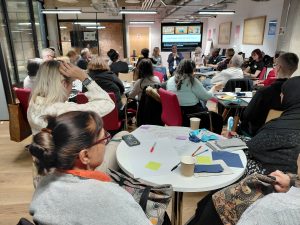
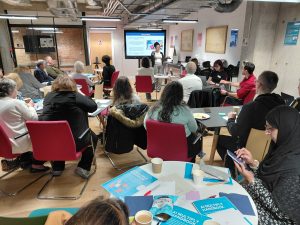
PPIE group members gathered for a vibrant final in-person meeting
On 8th October 2025, the AI-MULTIPLY PPIE group gathered for a vibrant final in-person meeting at Queen Mary University of London.
The day featured rich discussions and creative sessions, including a powerful Forum Theatre presentation by Lawnmowers, insights into project impact and evaluation, and a showcase of animations created by Lizzie Remfry.
Led by contributors across the team, the agenda celebrated collaboration, reflection, and next steps, culminating in the unveiling of the PPIE Handbook and heartfelt thanks to all involved.

PPIE Members present at the International Creative Methods Conference
(From left to right, Claire Hills-Wilson, Lawnmowers creative director, Francis, Lawnmowers actor, Sue Mountain, Fiona Cammack and Victoria Bartle (PPIE contributors on AI-MULTIPLY). All holding creative methods conference cupcakes.)
Last week, members of our PPIE (Patient and Public Involvement and Engagement) group had the opportunity to present at the International Creative Methods Conference. The session explored the potential of creative methodologies as alternatives to traditional research approaches, particularly in making research more accessible, inclusive, and collaborative.
They shared their journey working with Lawnmowers Theatre Company, highlighting how involving people with Learning Disabilities in the AI-MULTIPLY project not only enriched the research process but also challenged conventional ideas about who research is for and by.
Their presentation walked the audience through:
- The rationale for using creative methods in research;
- The unique contribution of co-production with people with Learning Disabilities;
- Why involvement in AI development and implementation is both crucial and transformative;
- What they hoped to achieve through this creative collaboration — not just in terms of outcomes, but in shaping how we work and who gets to be involved.
It was a fantastic opportunity to connect with others exploring similar approaches, and to reflect on how creativity can break down barriers and build more inclusive research futures.
Please read Victoria Bartle’s Blog with further details about the conference. http://ai-multiply.co.uk/wp-content/uploads/2025/09/International-Creative-Methods-Conference-Blog-Victoria-Bartle.docx

The stage setting for their performance.
Creative Research Methods Conference 2025
#ICRMC #ICRMC25